Heart Attack or Sudden Cardiac Arrest: How Are They Different?

Heart Attack or Sudden Cardiac Arrest: How Are They Different?

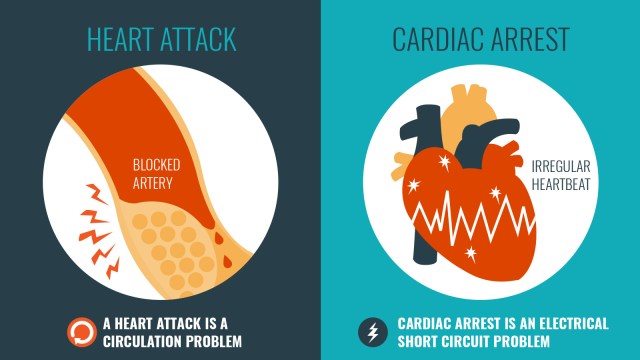
People often use these terms interchangeably, but they are not synonyms.heart attack is when blood flow to the heart is blocked, and sudden cardiac arrest is when the heart malfunctions and suddenly stops beating unexpectedly. A heart attack is a “circulation” problem and sudden cardiac arrest is an “electrical” problem.

What is a heart attack?
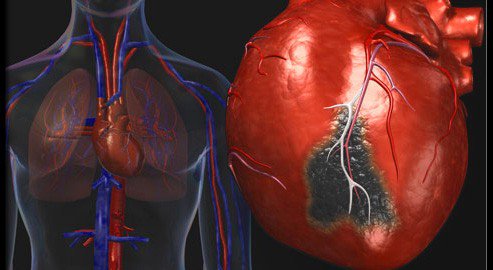
A heart attack occurs when a blocked artery prevents oxygen-rich blood from reaching a section of the heart. If the blocked artery is not reopened quickly, the part of the heart normally nourished by that artery begins to die. The longer a person goes without treatment, the greater the damage.

Symptoms of a heart attack may be immediate and intense. More often, though, symptoms start slowly and persist for hours, days or weeks before a heart attack. Unlike with sudden cardiac arrest, the heart usually does not stop beating during a heart attack. The heart attack symptoms in women can be different than men.

What is cardiac arrest?
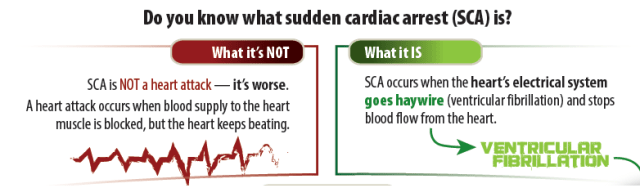
Sudden cardiac arrest occurs suddenly and often without warning. It is triggered by an electrical malfunction in the heart that causes an irregular heartbeat (arrhythmia). With its pumping action disrupted, the heart cannot pump blood to the brain, lungs and other organs. Seconds later, a person loses consciousness and has no pulse. Death occurs within minutes if the victim does not receive treatment.
What is the link?

These two distinct heart conditions are linked. Sudden cardiac arrest can occur after a heart attack, or during recovery.  Heart attacks increase the risk for sudden cardiac arrest. Most heart attacks do not lead to sudden cardiac arrest. But when sudden cardiac arrest occurs, heart attack is a common cause. Other heart conditions may also disrupt the heart’s rhythm and lead to sudden cardiac arrest. These include a thickened heart muscle (cardiomyopathy), heart failure, arrhythmias, particularly ventricular fibrillation, and long Q-T syndrome.

Fast action can save lives. Do follow us to find out what to do if someone experiences a heart attack or cardiac arrest.


To Your Safety,
Faisal Javed Mir & First Aid to Save a Life

Did you like the post? Let’s get connected on FacebookLinkedInTwitter & YouTube.

You might also like:
Basic Life Support (BLS) Session in Karachi
2-Days Practical First Aid & CPR Session in Karachi
Practical First Aid & CPR Session in Lahore
Practical First Aid & CPR Session in Faisalabad
Family First Aid Course
Community Training Programs
Upcoming Training Courses
Posted in First Aid CPR and AED | Tagged , , , , , , , , , , , , , , , , , , , , , , , , , , , , , , , , , , , , , , , , , , , , , , , , , , , , , , , , , , , , , , , , , , , , , , , , , , , , , , , , , , , , , , , , , , , , , , , , , , , , , , , , | Leave a comment

Certified First Aid & CPR | Sep 29 | Lahore

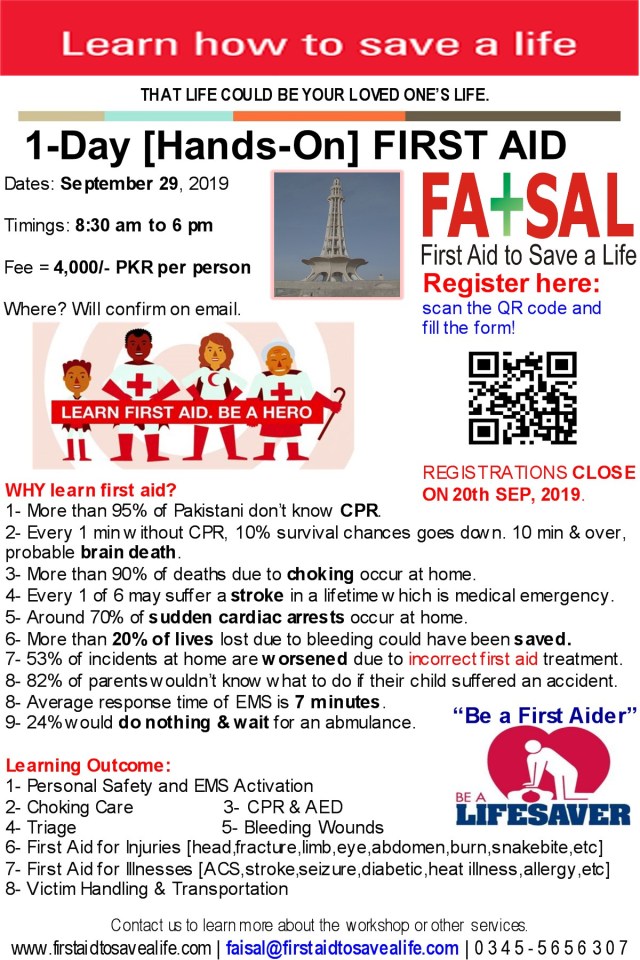
First Aid to Save a Life (FATSAL) is pleased to announce “CPR, AED & First Aid” hands-on training in Lahore on September 29, 2019. Our courses are designed for anyone with little or no medical training who needs a course completion card for job, regulatory (for example, company/industry requirement), or other requirements. These courses can also be taken by anyone who wants to be prepared for an emergency in any setting. Successful students receive a course completion card that is valid for 2 years.

National Course: The course fee is =4,000/- PKR per person inclusive of course notes, certification, refreshments & lunch.

MEDIC First Aid International (USA) Course: The course fee is =13,000/- PKR per person inclusive of course book, quick wallet card, MEDIC First Aid certification, refreshments and lunch.

Click here to download the sample course book of MEDIC First Aid.

When: 8:30 am – 6 pm

This training program is designed specifically for the first aid care provider and exceeds local and industry requirements. Our courses are video based, are instructor led, and feature group interaction and hands-on coaching and feedback from experienced Instructors. Skills are taught with the AHA’s research-proven practice-while-watching technique that allows students to practice skills as the video guides them. This course is based on the current guidelines for CPR and First Aid.

By the end of the session, participants will be able to understand and perform:

  • Role of the first aid care provider
  • Care for conscious and unconscious choking victims – practical of anti-choking practices
  • Perform CPR – hands-on session
  • Recovery position – practical exercise
  • Use of AED – practical by participants
  • Give first aid for a variety of injuries, such as burn, fracture, eye injury, bleeding control, head, neck & back injuries, and heat & cold-related emergencies. There are variety of scenarios for hands-on practice.
  • Manage sudden illnesses, heart attack, stroke, seizure, bites, poisoning, diabetics and many other topics.

This course will help students gain the knowledge, skills and confidence necessary to manage a medical emergency using CPR and first aid until more advanced help is available. Kindly remember that we have limited seats available so don’t wait for last day. Do grab your mobile/system and finalize your registration as early as possible to confirm your participation.

Kindly visit our upcoming trainings page for more comprehensive details and/or our online registration page. Do let us know if you have 1o or more number of delegates to be trained in one city and we can join you there to run the session for your organization.


To Your Safety,
Faisal Javed Mir & First Aid to Save a Life

Did you like the post? Let’s get connected on FacebookLinkedInTwitter & YouTube.

You might also like:
Certified First Aid, CPR & AED on Sep 21-22 in Karachi
Basic Life Support on Sep 23 in Karachi
Certified First Aid, CPR & AED on Oct 27 in Faisalabad
Certified First Aid, CPR & AED on Nov 3 in Islamabad
Certified First Aid, CPR and AED on Nov 17 in Peshawar
Basic Life Support on Nov 24 in Faisalabad
Basic Life Support on Dec 15 in Multan
Basic Life Support on Dec 22 in Peshawar
Basic Life Support on Dec 29 in Lahore
Upcoming Training Courses

Posted in First Aid CPR and AED | Tagged , , , , , , , , , , , , , , , , , , , , , , , , , , , , , , , , , , , , , , , , , , , , , , , , , , , , , , , , , , , , , , , , , , , , , , , , , , , , , , , , , , , , , , , , , , , , , , , , , , , , , , , , , , , , , , , , , , , , , , , , , , , , , , , , , , , , , , , , , , , , , , , , , , , , , , , , , , , , , , , , , , , , , , , , , , , , , , , , , , , , , , , , , , , , , , , , , , , , , , , , , , , , , , , , , , , , , , , , , , , , , , , , , , , , , , , , , , , , , , , , , , , , , , , , , , , , , , , , , , , , , , , , , , , , , , , , , , , , , , , , , , , , , , , , , , , , , , , , , , , , , , , , , , , , , , , , , , , , , , , , , , , , , , , , , , , , , , , , , , , , , , , , , , , , , , , , , , , , , , , , , , , , , , , , , , , , , , , , , , , , , , , , , , , , , , , , , , , , , , , , , , , , , | Leave a comment

First Aid & CPR on this World Heart Day | Sep 21-22 | Karachi

First Aid to Save a Life (FATSAL) is pleased to announce 2-days “CPR, AED & First Aid” hands-on training in Karachi on September 21-22, 2019.

National Course: The course fee is =7,000/- PKR per person inclusive of course notes, certification, refreshments & lunch on both days.

International Course: The course fee is =15,000/- PKR per person inclusive of course book, quick wallet card, MEDIC First Aid certification, refreshments and lunch on both days.

The last date to register and pay course fee is: September 7, 2019.

When: 9:30 am – 04:30 pm

This training program is designed specifically for the first aid care provider and exceeds local and industry requirements. This course is based on the current guidelines for CPR and First Aid.

By the end of the session, participants will be able to understand and perform:

  • Role of the first aid care provider
  • Care for conscious and unconscious choking victims – practical of anti-choking practices
  • Perform CPR – hands-on session
  • Recovery position – practical exercise
  • Use of AED – practical by participants
  • Give first aid for a variety of injuries, such as burn, fracture, eye injury, bleeding control, head, neck & back injuries, and heat & cold-related emergencies. There are variety of scenarios for hands-on practice.
  • Manage sudden illnesses, heart attack, stroke, seizure, bites, poisoning, diabetics and many other topics.

This course will help students gain the knowledge, skills and confidence necessary to manage a medical emergency using CPR and first aid until more advanced help is available. Kindly remember that we have limited seats available so don’t wait for last day. Do grab your mobile/system and finalize your registration as early as possible to confirm your participation.

Kindly visit our upcoming trainings page for more comprehensive details and/or our online registration page. Do let us know if you have 1o or more number of delegates to be trained in one city and we can join you there to run the session for your organization.


To Your Safety,
Faisal Javed Mir & First Aid to Save a Life

Did you like the post? Let’s get connected on FacebookLinkedInTwitter & YouTube.

You might also like:
Basic Life Support (BLS) Session in Karachi
PediatricPlus CPR, AED and First Aid Course
Advanced Bleeding Control Course
CarePlus CPR and AED for All – Adult, Children and Infants
Practical First Aid & CPR Session in Lahore
Practical First Aid & CPR Session in Faisalabad
Family First Aid Course
Community Training Programs
Upcoming Training Courses
Posted in First Aid CPR and AED | Tagged , , , , , , , , , , , , , , , , , , , , , , , , , , , , , , , , , , , , , , , , , , , , , , , , , , , , , , , , , , , , , , , , , , , , , , , , , , , , , , , , , , , , , , , , , , , , , , , , , , , , , , , , , , , , , , , , , , , , , , , , , , , , , , , , , , , , , , , , , , , , , , , , , , , , , , , , , , , , , , , , , , , , , , , , , , , , , , , , , , , , , , , , , , , , , , , , , , , , , , , , , , , , , , , , , , , , , , , , , , , , , , , , , , , , , , , , , , , , , , , , , , , , , , , , , , , , , , , , , , , , , , , , , , , , , , , , , , , , , , , , , , , , , , , , , , , , , , , , , , , , , , , , , , , , , , , , , , , , , , , , , , , , , , , , , , , , , , , , , , , , , , , , , , , , , , , , , , , , , , , , , , , , , , , , , , , , , , , , , , , , , , , , , , , , , , , , , , , , , , , , , , | Leave a comment

Basic Life Support | Sep 23 | Karachi

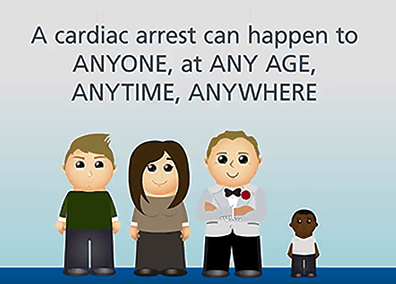
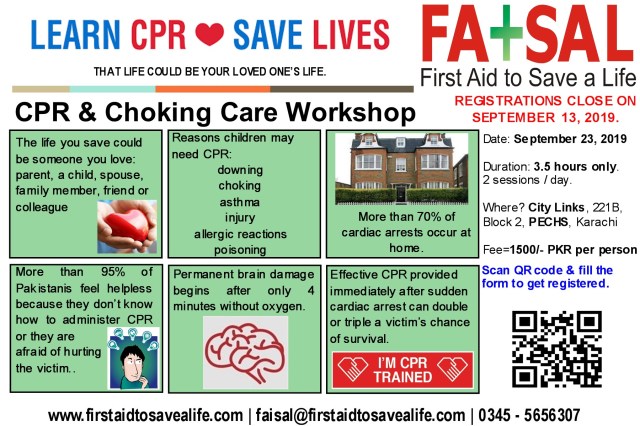
Cardiac arrest can happen to anyone, at any age, anytime, anywhere. Are you prepared to give care (CPR) to save lives?

FATSAL is pleased to announce number of Basic Life Support sessions in different cities of Pakistan to raise awareness about cardiac emergencies and train people in CPR and anti-choking skills and build more resilient communities. Our objective is to prepare early and Save Lives.

First Aid to Save a Life is proud to offer hands-on skills session to teach lifesaving skills to save lives. Our Basic Life Support (#BLS) Course trains participants to promptly recognize several life-threatening emergencies, give high-quality chest compressions, deliver appropriate ventilations and provide early use of an #AED.

In our hands-on approach, students participate in scenarios and learning stations.

Features
• Reflects science and education from the 2017 #AHA Guidelines Update for #CPR and #ECC .
• Instructor-led, hands-on class format reinforces skills proficiency.
• Emphasis on high-quality CPR including a team dynamics classroom activity.
• Video-based course with real world scenarios.

Course Content
• High-quality CPR for adults, children, and infants
• Chain of Survival
• Use of an AED
• Effective ventilations using a barrier device
• Importance of teams in multirescuer resuscitation and performance as an effective team member during multirescuer CPR
• Relief of foreign-body airway obstruction (#choking) for adults, children and infants.

We have limited seats to maintain the #quality of training so don’t wait for last day. The fee includes refreshment, quick card and #certification.

Workshop Fee: = 1500/- PKR per person                        Last Date: Sep 13, 2019
Late Fee: =1750/- PKR per person

These workshops are open for ages 15 & over. Pre registration is must. The participants would be limited and the best equipment to student ratio to be maintained to ensure quality learning.

These workshops are must do for all. These are great for parents as 82% of parents would not know what to do if their children choked, burned themselves or collapsed. More than 70% of cardiac emergencies occur at home. Its high time to get trained, become a lifesaver and save lives.

This is going to be a learning by doing session where you can call upon your family, friends & colleagues to challenge in CPR skills. So learning with fun filled competition. I hope you spread the word & bring along more challengers who are willing to learn life saving skills – CPR & anti-choking care.


For Your Safety,
Faisal Javed Mir & First Aid to Save a Life

Did you like the post? Let’s get connected on FacebookLinkedInTwitter & YouTube.

You might also like:
ASHI Basic Life Support (BLS)
2-Days Practical First Aid & CPR Session in Karachi
Practical First Aid & CPR Session in Lahore
Practical First Aid & CPR Session in Faisalabad
Family First Aid Course
Community Training Programs
Upcoming Training Courses

Posted in CPR and AED, CPR and AED Manikins, Workshops, World Heart Congress, World Heart Day | Tagged , , , , , , , , , , , , , , , , , , , , , , , , , , , , , , , , , , , , , , , , , , , , , , , , , , , , , , , , , , , , , , , , , , , , , , , , , , , , , , , , , , , , , , , , , , , , , , , , , , , , , , , , , , , , , , , , , , , , , , , , , , , , , , , , , , | Leave a comment

Emergency Treatment of Cardiac Arrest

Cardiac arrest can strike without warning.

Do you suspect that someone is experiencing cardiac arrest? Here are the signs:

  • Sudden loss of responsiveness The person doesn’t respond, even if you tap him or her hard on the shoulders, or ask loudly if he or she is OK. The person doesn’t move, speak, blink or otherwise react.
  • No normal breathing The person isn’t breathing or is only gasping for air.

What to do

If you witness a cardiac arrest, it’s crucial to call 1122/EMS and start CPR immediately. To learn how to perform CPR, follow these simple steps:

  • Step 1: Shake and shout
  • Step 2: Check for normal breathing
  • Step 3: Call 1122/EMS
  • Step 4: Give 30 chest compressions
  • Step 5: Give 2 rescue breaths
  • Step 6: Repeat until an ambulance arrives

Remember – even if you haven’t been trained in CPR with rescue breathing, you can still use hands-only CPR.

Step 1: Shake and shout

If you come across someone who is unconscious, always check for danger and look for risks before you start helping.

  • Check for a response – gently shake the person’s shoulders and ask loudly ‘are you alright?’
  • Shout for help – if someone is nearby, ask them to stay as you might need them. If you are alone, shout loudly to attract attention, but don’t leave the person.

Step 2: Check for normal breathing

Someone having a cardiac arrest won’t be breathing, or won’t be breathing normally. They also won’t be conscious. Keeping their head back, check if the person is breathing normally by looking for:

  • regular chest movements
  • listening for breathing
  • feeling for breath on your cheek.

Look, listen and feel for no more than 10 secondsDon’t confuse gasps with normal breathing. If you’re not sure if their breathing is normal, act as if it’s not normal.

  • If you’re sure the person is breathing normally, then put them in the recovery position and call 1122/EMS.
  • If breathing isn’t normal, open their airway. Place one hand on the person’s forehead, gently tilt their head back, then lift their chin using two fingers of your other hand under their chin – when you do this you open their airway.

Step 3: Call 1122/EMS

If the person is not breathing or not breathing normally:

  • ask someone to call 1122/EMS immediately and ask for an ambulance
  • check if AED is available and use it.

If you can’t find anyone to help, call 1122/EMS before you start CPR.

Step 4: Give 30 chest compressions

  • Kneel next to the person.
  • Place the heel of one hand in the centre of their chest. Place your other hand on top of the first. Interlock your fingers.
  • With straight arms, use the heel of your hand to push the breastbone down firmly and smoothly, so that the chest is pressed down between 5–6 cm, and release.
  • Do this at a rate of 100 to 120 chest compressions per minute – that’s around 2 per second.
  • Give 30 chest compressions.

Step 5: Give two rescue breaths

  • Open the airway again by tilting the head back and lifting the chin. Pinch the soft part of the person’s nose closed.
  • Take a normal breath, make a seal around their mouth and breathe out steadily.
  • The person’s chest should rise and fall. Keeping the person’s head back and the chin lifted, take your mouth away, take another normal breath, and give a second rescue breath. The two breaths should take no longer than five seconds.

Step 6: Repeat until an ambulance arrives

  • Repeat 30 compressions and 2 rescue breaths.

If you’d rather not give rescue breaths then call 1122/EMS and deliver hands-only CPR. That’s better than doing nothing.

Keep going until professional help arrives and takes over, or the person starts to show signs of regaining consciousness, such as coughing, opening their eyes, speaking, or breathing normally.

If you’re feeling tired, and there’s someone nearby to help, instruct them to continue.

Who can you save with CPR?

The life you save with CPR is mostly likely to be a loved one. More than 80% of OHCA occurs at home.

FATSAL is pleased to announce series of CPR Workshops (BLS Courses) in IslamabadLahore, Karachi, Multan, Faisalabad & Peshawar to raise awareness about cardiac emergencies and train people in CPR and anti-choking skills to save lives.

These workshops are 3.5-hours session where adult, child and infant manikins would be available for hands-on learning. Also the anti-choking trainer would be there to learn how to relief choking person.

These workshops are open for ages 15 and overPre-registration is must. The workshop fee for per person (=1500/- PKR) which includes wallet card for quick reference, certificate and tea/refreshment. There would be only 12 participants & appropriate equipment/supplies available to ensure you have ample time and quality learning session. There are multiple sessions on any given day.

To Your Safety,
Faisal Javed Mir & First Aid to Save a Life

Did you like the post? Let’s get connected on FacebookLinkedInTwitter & YouTube.

You might also like:
Basic Life Support (BLS) Session in Karachi
2-Days Practical First Aid & CPR Session in Karachi
Practical First Aid & CPR Session in Lahore
Practical First Aid & CPR Session in Faisalabad
Family First Aid Course
Community Training Programs
Upcoming Training Courses
Posted in First Aid CPR and AED | Tagged , , , , , , , , , , , , , , , , , , , , , , , , , , , , , , , , , , , , , , , , , , , , , , , , , , , , , , , , , , , , , , , , , , , , , , , , , , , , , , , , , , , , , , , , , , , , , , , , , , , | Leave a comment

First Aid Save Lives | Sep 29 | Lahore

First Aid to Save a Life (FATSAL) is pleased to announce “CPR, AED & First Aid” hands-on training, based on most updated and latest guidelines, in Lahore on September 29, 2019 (part of our World Heart Day campaign).

National Course: The course fee is =4,000/- PKR per person inclusive of course notes, certification, refreshments & lunch on both days.

International Course: The course fee is =13,000/- PKR per person inclusive of course book, quick wallet card, MEDIC First Aid certification, refreshments and lunch on both days.

The last date to register and pay course fee is: September 22, 2019.

When: 8:30 am – 06 pm


This training program is designed specifically for the first aid care provider and exceeds local and industry requirements. This course is based on the current guidelines for CPR and First Aid.

By the end of the session, participants will be able to understand and perform:

  • Role of the first aid care provider
  • Care for conscious and unconscious choking victims – practical of anti-choking practices
  • Perform CPR – hands-on session
  • Recovery position – practical exercise
  • Use of AED – practical by participants
  • Give first aid for a variety of injuries, such as burn, fracture, eye injury, bleeding control, head, neck & back injuries, and heat & cold-related emergencies. There are variety of scenarios for hands-on practice.
  • Manage sudden illnesses, heart attack, stroke, seizure, bites, poisoning, diabetics and many other topics.

This course will help students gain the knowledge, skills and confidence necessary to manage a medical emergency using CPR and first aid until more advanced help is available. Kindly remember that we have limited seats available so don’t wait for last day. Do grab your mobile/system and finalize your registration as early as possible to confirm your participation.

Kindly visit our upcoming trainings page for more comprehensive details and/or our online registration page. Do let us know if you have 1o or more number of delegates to be trained in one city and we can join you there to run the session for your organization.


To Your Safety,
Faisal Javed Mir & First Aid to Save a Life

Did you like the post? Let’s get connected on FacebookLinkedInTwitter & YouTube.

You might also like:
Basic Life Support (BLS) Session in Karachi
2-Days Practical First Aid in Karachi on Sep 21-22
Advanced Bleeding Control Course
CarePlus CPR and AED for All – Adult, Children and Infants
Practical First Aid & CPR Session in Faisalabad
Family First Aid Course
Community Training Programs
Upcoming Training Courses

Posted in First Aid CPR and AED | Tagged , , , , , , , , , , , , , , , , , , , , , , , , , , , , , , , , , , , , , , , , , , , , , , , , , , , , , , , , , , , , , , , , , , , , , , , , , , , , , , , , , , , , , , , , , , , , , , , , , , , , , , , , , , , , , , , , , , , , , , , , , , , , , , , , , , , , , , , , , , , , , , , , , , , , , , , , , , , , , , , , , , , , , , , , , , , , , , , , , , , , , , , , , , , , , , , , , , , , , , , , , , , , , , , , , , , , , , , , , , , , , , , , , , , , , , , , , , , , , , , , , , , , , , , , , , , , , , , , , , , , , , , , , , , , , , , , , , , , , , , , , , , , , , , , , , , , , , , , , , , , , , , , , , , , , , , , , , , , , , , , , , , , , , , , , , , , , , , , , , , , , , , , , , , , , , , , , , , , , , , , , , , , , , , , , , , , , , , , , , , , , , , , , , , , , , , , , , , , , , , , | Leave a comment

Practical First Aid & CPR | Sep 21-22 | Karachi

First Aid to Save a Life (FATSAL) is pleased to announce 2-days “CPR, AED & First Aid” hands-on training in Karachi on September 21-22, 2019.

National Course: The course fee is =7,000/- PKR per person inclusive of course notes, certification, refreshments & lunch on both days.

International Course: The course fee is =15,000/- PKR per person inclusive of course book, quick wallet card, MEDIC First Aid certification, refreshments and lunch on both days.

The last date to register and pay course fee is: September 7, 2019.

When: 9:30 am – 04:30 pm

This training program is designed specifically for the first aid care provider and exceeds local and industry requirements. This course is based on the current guidelines for CPR and First Aid.

By the end of the session, participants will be able to understand and perform:

  • Role of the first aid care provider
  • Care for conscious and unconscious choking victims – practical of anti-choking practices
  • Perform CPR – hands-on session
  • Recovery position – practical exercise
  • Use of AED – practical by participants
  • Give first aid for a variety of injuries, such as burn, fracture, eye injury, bleeding control, head, neck & back injuries, and heat & cold-related emergencies. There are variety of scenarios for hands-on practice.
  • Manage sudden illnesses, heart attack, stroke, seizure, bites, poisoning, diabetics and many other topics.

This course will help students gain the knowledge, skills and confidence necessary to manage a medical emergency using CPR and first aid until more advanced help is available. Kindly remember that we have limited seats available so don’t wait for last day. Do grab your mobile/system and finalize your registration as early as possible to confirm your participation.

Kindly visit our upcoming trainings page for more comprehensive details and/or our online registration page. Do let us know if you have 1o or more number of delegates to be trained in one city and we can join you there to run the session for your organization.


To Your Safety,
Faisal Javed Mir & First Aid to Save a Life

Did you like the post? Let’s get connected on FacebookLinkedInTwitter & YouTube.

You might also like:
Basic Life Support (BLS) Session in Karachi
PediatricPlus CPR, AED and First Aid Course
Advanced Bleeding Control Course
CarePlus CPR and AED for All – Adult, Children and Infants
Practical First Aid & CPR Session in Lahore
Practical First Aid & CPR Session in Faisalabad
Family First Aid Course
Community Training Programs
Upcoming Training Courses

Posted in First Aid CPR and AED | Tagged , , , , , , , , , , , , , , , , , , , , , , , , , , , , , , , , , , , , , , , , , , , , , , , , , , , , , , , , , , , , , , , , , , , , , , , , , , , , , , , , , , , , , , , , , , , , , , , , , , , , , , , , , , , , , , , , , , , , , , , , , , , , , , , , , , , , , , , , , , , , , , , , , , , , , , , , , , , , , , , , , , , , , , , , , , , , , , , , , , , , , , , , , , , , , , , , , , , , , , , , , , , , , , , , , , , , , , , , , , , , , , , , , , , , , , , , , , , , , , , , , , , , , , , , , , , , , , , , , , , , , , , , , , , , , , , , , , , , , , , , , , , , , , , , , , , , , , , , , , , , , , , , , , , , , , , , , , , , , , , , , , , , , , , , , , , , , , , , , , , , , , , , , , , , , , , , , , , , , , , , , , , , , , , , , , , , , , , , , , , , , , , , , , , , , , , , , , , , , , , , | Leave a comment

Causes of Cardiac Arrest

Causes of Cardiac Arrest

Cardiac arrest may be caused by almost any known heart condition.

Most cardiac arrests occur when a diseased heart’s electrical system malfunctions. This malfunction causes an abnormal heart rhythm such as ventricular tachycardia or ventricular fibrillation. Some cardiac arrests are also caused by extreme slowing of the heart’s rhythm (bradycardia).

Irregular heartbeats such as these that can cause cardiac arrest should be considered life-threatening arrhythmias.

Other causes of cardiac arrest include:

  • Scarring of the heart tissue Such scarring may be the result of a prior heart attack or another cause. A heart that’s scarred or enlarged from any cause is prone to develop life-threatening ventricular arrhythmias. The first six months after a heart attack represents a particularly high-risk period for sudden cardiac arrest in patients with atherosclerotic heart disease.
  • A thickened heart muscle (cardiomyopathy) Damage to the heart muscle can be the result of high blood pressure, heart valve disease or other causes. A diseased heart muscle can make you more prone to sudden cardiac arrest, especially if you also have heart failure. Learn more about cardiomyopathy.
  • Heart medications Under certain conditions, various heart medications can set the stage for arrhythmias that cause sudden cardiac arrest. (As odd as it may sound, antiarrhythmic drugs used to treat arrhythmias can sometimes produce ventricular arrhythmias even at normally prescribed doses. This is called a “proarrhythmic” effect.) Significant changes in blood levels of potassium and magnesium (from using diuretics, for example) also can cause life-threatening arrhythmias and cardiac arrest.
  • Electrical abnormalities Certain electrical abnormalities such as Wolff-Parkinson-White syndrome and Long QT syndrome may cause sudden cardiac arrest in children and young people.
  • Blood vessel abnormalities In rare cases, congenital blood vessel abnormalities, particularly in the coronary arteries and aorta, may cause cardiac arrest. Adrenaline released during intense physical activity often acts as a trigger for sudden cardiac arrest when these abnormalities are present.
  • Recreational drug use: Use of certain recreational drugs can cause sudden cardiac arrest, even in otherwise healthy people.
  • Electrocution: Accidental contact with electrical connections can also disturb the normal heart rhythm.

Cardiac arrest can strike without warning.

Do you suspect that someone is experiencing cardiac arrest? Here are the signs:

  • Sudden loss of responsiveness The person doesn’t respond, even if you tap him or her hard on the shoulders, or ask loudly if he or she is OK. The person doesn’t move, speak, blink or otherwise react.
  • No normal breathing The person isn’t breathing or is only gasping for air.


To Your Safety,
Faisal Javed Mir & First Aid to Save a Life

Did you like the post? Let’s get connected on FacebookLinkedInTwitter & YouTube.

You might also like:
Basic Life Support (BLS) Session in Karachi
2-Days Practical First Aid & CPR Session in Karachi
Practical First Aid & CPR Session in Lahore
Practical First Aid & CPR Session in Faisalabad
Family First Aid Course
Community Training Programs
Upcoming Training Courses

Posted in First Aid CPR and AED | Tagged , , , , , , , , , , , , , , , , , , , , , , , , , , , , , , , , , , , , , , , , , , , , , , , , , , , , , , , , , , , , , , , , , , , , , , , , , , , , , , , , , , , , , , , | Leave a comment

Cardiac Arrest

What is cardiac arrest?

Cardiac arrest is the abrupt loss of heart function in a person who may or may not have been diagnosed with heart disease. It can come on suddenly, or in the wake of other symptoms. Cardiac arrest is often fatal, if appropriate steps aren’t taken immediately.

Each year in the United States, more than 350,000 cardiac arrests occur outside of a hospital setting.

Is a heart attack the same as cardiac arrest?

No. The term “heart attack” is often mistakenly used to describe cardiac arrest. While a heart attack may cause cardiac arrest, the two terms don’t mean the same thing.

Heart attacks are caused by a blockage that stops blood flow to the heart. A heart attack (or myocardial infarction) refers to death of heart muscle tissue due to the loss of blood supply. Heart attack can be understood as a “circulation” problem. A heart attack is quite serious, sometimes fatal.

By contrast, cardiac arrest is caused when the heart’s electrical system malfunctions. The heart stops beating properly. Hence the name: The heart’s pumping function is “arrested,” or stopped.

In cardiac arrest, death can result quickly if proper steps aren’t taken immediately. Cardiac arrest may be reversed if CPR  is performed and a defibrillator is used to shock the heart and restore a normal heart rhythm within a few minutes.

Cardiac arrest may be caused by irregular heart rhythms, called arrhythmias. A common arrhythmia associated with cardiac arrest is ventricular fibrillation. Ventricular fibrillation means that the heart’s lower chambers suddenly start beating chaotically and don’t pump blood.


To Your Safety,
Faisal Javed Mir & First Aid to Save a Life

Did you like the post? Let’s get connected on FacebookLinkedInTwitter & YouTube.

You might also like:
Basic Life Support (BLS) Session in Karachi
2-Days Practical First Aid & CPR Session in Karachi
Practical First Aid & CPR Session in Lahore
Practical First Aid & CPR Session in Faisalabad
Family First Aid Course
Community Training Programs
Upcoming Training Courses
Posted in First Aid CPR and AED | Tagged , , , , , , , , , , , , , , , , , , , , , , , , , , , , , , , , , , , , , , , , , , , , , , , , , , , , , , , , , , , , , , , , , , , , , , , , , , , , , , , , , , , | Leave a comment

Cough CPR

Cough CPR and AHA Guidelines

The American Heart Association does not endorse “cough CPR,” a coughing procedure widely publicized on the Internet. As noted in the 2010 American Heart Association Guidelines for Cardiopulmonary Resuscitation and Emergency Cardiovascular Care, “cough CPR” is not useful for unresponsive victims and should not be taught to lay rescuers.

During a sudden arrhythmia (abnormal heart rhythm), it may be possible for a conscious, responsive person to cough forcefully and repetitively to maintain enough blood flow to the brain to remain conscious for a few seconds until the arrhythmia is treated. Blood flow is maintained by increased pressure in the chest that occurs during forceful coughs. This has been mislabeled “cough CPR,” although it’s not a form of traditional resuscitation.

Why isn’t “cough CPR” appropriate in CPR training courses?

“Cough CPR” should not be taught in lay-rescuer CPR courses because it is generally not useful in the prehospital setting. In virtually all lay-rescuer CPR courses, the finding that signals an emergency is the victim’s unresponsiveness. Unresponsive victims will not be able to perform “cough CPR” but rescuer has to perform conventional CPR to Save his or her life.

Are there situations when “cough CPR” is appropriate?

“Cough CPR” may be considered in settings such as the cardiac catheterization laboratory where patients are conscious and constantly monitored. A nurse or physician is also present who can instruct and coach the patients to cough forcefully every one to three seconds during the initial seconds of a sudden arrhythmia. However, as this is not effective in all patients, it should not delay definitive treatment.

AHA Recommendation

The best strategy is to be aware of the warning signs for cardiac arrest – sudden loss of responsiveness and no normal breathing – and respond to them by calling EMS (1122 in Punjab & KPK or your emergency response number).


To Your Safety,
Faisal Javed Mir & First Aid to Save a Life

Did you like the post? Let’s get connected on FacebookLinkedInTwitter & YouTube.

You might also like:
Basic Life Support (BLS) Session in Karachi
2-Days Practical First Aid & CPR Session in Karachi
Practical First Aid & CPR Session in Lahore
Practical First Aid & CPR Session in Faisalabad
Family First Aid Course
Community Training Programs
Upcoming Training Courses

Posted in World Heart Congress, World Heart Day | Tagged , , , , , , , , , , , , , , , , , , , , , , , , , , , , , , , , , , , , , , , , , , , , , , , , , , , , , , , , , , , , , , , , , , | Leave a comment