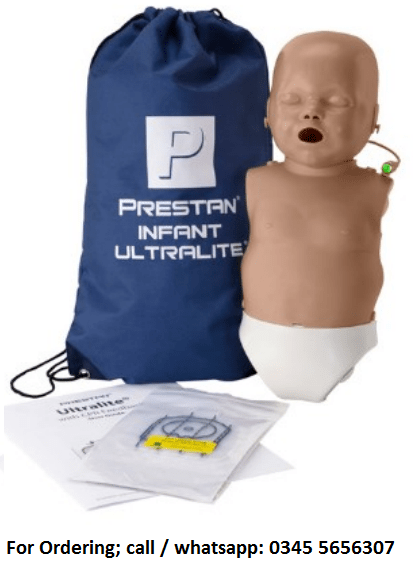
Infant CPR/AED Training Manikin

Introducing the NEW PRESTAN Infant Ultralite® CPR Training Manikin

PRESTAN is committed to building confidence in CPR training by expanding our most compact, lightweight product offering designed to meet instructors needs in a full range of training environments including on-the-go & virtual training!

Available in three lightweight, easy-to-transport sizes, including:

 *Single – 1.6 pounds

 *4-pack – 5.8 pounds

 *12-pack – 15.5 pounds

Posted in First Aid CPR and AED | Tagged , , , , , , , , , , , , | Leave a comment

First Aid for Sprains: Do I Use Ice or Heat?

Sprains are injuries to ligaments that hold your joints together and often result in severe pain, swelling, and bruising. The stretching and tearing within the ligaments can be uncomfortable and limit your range of motion. The most common type of sprain include ankles sprains, knee sprains and wrist sprains.

If you roll your ankle or experience a sprain in another area, you might be wondering, “Do I use ice or heat?” as the best treatment.

Sprains heal more quickly with the right care. So, it’s important to know whether to apply ice or heat as a first aid treatment immediately following a sprain.

Apply Ice for a New Sprain

Cold application decreases bleeding, swelling, pain, and disability associated with bone, joint, and muscle injuries. Therefore, with a sprained ankle or other affected area, you’ll want to cool the injured area immediately.

This is best accomplished with a plastic bag filled with a mixture of ice and water, which is better than using an ice pack or cold compress alone.

Keep in mind that mild sprains can often be treated at home, but severe sprains generally require additional medical advice.

Precaution:

However, you’ll need to be mindful and prevent injury to the skin by limiting each cold treatment to no more than 20 minutes.

Additionally, a barrier should be placed between the plastic bag and the skin. For example, a thin towel or piece of clothing both serve as a functional barrier.

Get First Aid Certified

Need to learn and practice how to properly splint an injured limb? Do you know what to do with a knocked-out tooth or how to treat a minor wound or other common injuries?

A basic first aid course will build your confidence to respond in a variety of medical emergency and non-emergency first aid situations.

Contact us for information about first aid courses near you.

Posted in First Aid CPR and AED | Tagged , , , , , , , , , , , | Leave a comment

Basic Life Support | Faisalabad | Sep 10, 2022

Basic Life Support (BLS) program is for participants to gain or improve knowledge and skill proficiency in high-quality CPR skills. In our hands-on approach, students participate in scenarios and learning stations to become a Lifesaver!

BLS reflects the latest resuscitation science and treatment recommendations published and conforms with the 2020 American Heart Association (AHA) Guidelines Update for CPR and ECC and the annual Guidelines Update.

Note: There are 10 seats available in Faisalabad’s session.


Course Topics Include

  • Sudden cardiac arrest
  • Secondary cardiac arrest
  • Basic life support assessment
  • Caring for respiratory arrest
  • Caring for cardiac arrest
  • High Quality CPR
  • Multiple provider approach for CPR
  • Safe use of an AED
  • Choking
  • Recovery Position

Only 10 seats in the course to offer you ample time and best equipment to student ratio for hands-on learning experience.

Class Audience

The intended audience is individuals who are healthcare providers, public safety professionals in a variety of occupational settings, or individuals enrolled in healthcare and public safety career training programs who require BLS training.

For immediate booking contact us on 0345 5656307 or register online.

Posted in First Aid CPR and AED | Tagged , , , , , , , , , , , , , , , , , , , , , | Leave a comment

Basic Life Support

Students learn how to recognize a life-threatening emergency, how to provide basic life support and what to do in case of an airway obstruction or choking. Basic Life Support (BLS) program is for participants to gain or improve knowledge and skill proficiency in high-quality CPR skills. In our hands-on approach, students participate in scenarios and learning stations.

BLS reflects the latest resuscitation science and treatment recommendations published and conforms with the 2020 American Heart Association (AHA) Guidelines Update for CPR and ECC and the annual Guidelines Update.

Course Topics Include

  • Sudden cardiac arrest
  • Basic life support assessment
  • Caring for respiratory arrest
  • Caring for cardiac arrest
  • High Quality CPR
  • Multiple provider approach for CPR
  • Safe use of an AED
  • Choking
  • Recovery Position

Only 6 seats in the course to offer you ample time and best equipment to student ratio for hands-on learning experience.

Class Audience

The intended audience is individuals who are healthcare providers (in and out of hospital), public safety professionals in a variety of occupational settings, or individuals enrolled in healthcare and public safety career training programs who require BLS training.

For immediate booking contact us on 0345 5656307 or register online.

Posted in First Aid CPR and AED | Tagged , , , , , , , , , , , , , , , , , , , , , , , , , , , , | Leave a comment

Basic Life Support including an AED

Students learn how to recognize a life-threatening emergency, how to provide basic life support and what to do in case of an airway obstruction or choking. Basic Life Support (BLS) program is for participants to gain or improve knowledge and skill proficiency in high-quality CPR skills. In our hands-on approach, students participate in scenarios and learning stations.

BLS reflects the latest resuscitation science and treatment recommendations published and conforms with the 2020 American Heart Association (AHA) Guidelines Update for CPR and ECC and the annual Guidelines Update.

Course Topics Include

  • Sudden cardiac arrest
  • Basic life support assessment
  • Caring for respiratory arrest
  • Caring for cardiac arrest
  • High Quality CPR
  • Multiple provider approach for CPR
  • Safe use of an AED
  • Choking
  • Recovery Position

Only 6 seats in the course to offer you ample time and best equipment to student ratio for hands-on learning experience.

Class Audience

The intended audience is individuals who are healthcare providers (in and out of hospital), public safety professionals in a variety of occupational settings, or individuals enrolled in healthcare and public safety career training programs who require BLS training.

For immediate booking contact us on 0345 5656307 or register online.

Posted in First Aid CPR and AED | Tagged , , , , , , , , , , , , , , , , , , | Leave a comment

Monitoring blood pressure at home can be tricky

Knowing your blood pressure is a basic part of good health. But monitoring it at home can get complicated.

“It sounds easy – you buy a device, smack the cuff on your upper arm and push a button, right? It’s not so easy,” said Dr. Daichi Shimbo, co-director of the Columbia Hypertension Center in New York.

High blood pressure is a common condition in adults that’s associated with “really bad consequences,” such as heart attacks, strokes and dementia, Shimbo said. To diagnose and track it, doctors often ask people to check it at home. But even professionals can get tripped up on the proper procedures for home blood pressure monitoring.

Here’s help with some of the basics.

What exactly do those numbers mean?

The top number in a reading measures systolic pressure, the force against artery walls when the heart beats. The bottom number, diastolic pressure, measures that same force between beats.

Dr. Karen Margolis, senior research investigator at HealthPartners Institute in Minneapolis, puts it this way: “The top number is when your heart is squeezing. The bottom number is when your heart is relaxing.” If you’re using a stethoscope, where a heartbeat sounds like “lub-dub,” the “lub” is the squeeze, and the “dub” is the relaxing.

The original measuring devices used mercury-filled tubes, delineated in millimeters. So blood pressure is expressed in millimeters of mercury.

Modern digital monitors don’t use mercury, but the principle is the same: A cuff around your arm cuts off blood flow in the artery inside your elbow. As the cuff is loosened, the “whoosh” of blood starting to flow again provides the systolic reading. When the noise stops, that’s the diastolic number.

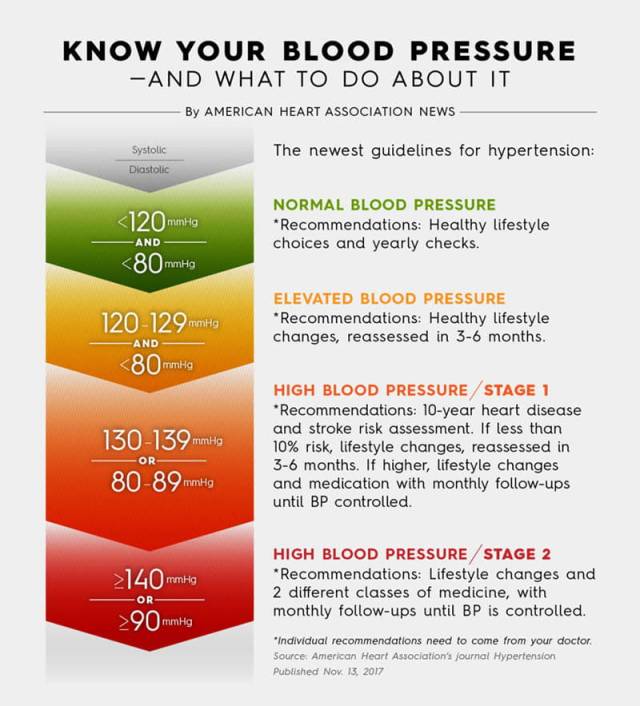
The American Heart Association and American College of Cardiology recognize five categories of blood pressure in adults. A reading of less than 120/80 is considered normal.
Where do I start?

Margolis and Shimbo agreed that proper self-monitoring of blood pressure starts with a validated device. Both co-authored a 2020 policy statement from the AHA and American Medical Association about home blood pressure monitoring.

Many devices tout Food and Drug Administration clearance. But the FDA does not validate the accuracy of devices it clears to be sold on the market, Shimbo said.

To find a validated device, start with the AMA website validatebp.org. An international consortium also lists validated devices at stridebp.org.

What kind of device should I use?

Upper arm cuff devices are preferred over wrist devices, according to the AHA/AMA report.

“I just find them really difficult to use,” Margolis said of the wrist devices. “They’re touchy. Your arm has to be in exactly the right position.” Still, people with medical issues that preclude compressing the arteries of both upper arms might need a wrist device, she said.

And cuff size matters. A “universal” cuff will work for most people, she said, but if you have a very slender or large arm, you’ll need an alternate.

Cuffless devices, including smartwatches, sound cool, Shimbo said. But few have been validated, so he considers them “not ready for primetime.”

How do I prepare for a measurement?

This is “surprisingly hard,” Margolis acknowledged. Before taking a reading, you should avoid caffeine. Don’t exercise for 30 minutes beforehand. If you smoke, don’t smoke. Go to the bathroom. “Ideally, you want to wait until 30 minutes after you’ve had a meal.”

Then sit quietly without any distractions for five minutes, Margolis said. “And when I say no distraction, I mean don’t watch TV. Don’t listen to a podcast. Don’t read a book. Definitely don’t read the newspaper or listen to the news.”

What else is important?

According to guidelines from the AHA and ACC, sit in a chair that supports your back. Keep your feet flat on the ground. Don’t cross your legs. Position and support your upper bare arm at heart level. Keep your palm up and your arm muscles relaxed. Don’t talk.

Take two readings at least one minute apart.

Not following these steps can throw a reading off significantly. A reading taken over clothing, for example, can be off by 5 to 50 points.

Posted in First Aid CPR and AED | Leave a comment

CPR training and 10 marks

Hello Students,

How would you like 10 extra marks if you learn the life saving skill of CPR?

Government of Pakistan has decided to launch national CPR training for masses. They are accepting people of age 14 and over and has decided to give 10 marks to every successful trainee.

Benefits:

1- You will get to learn lifesaving skill – CPR.

2- More than 70% of cardiac arrests occur at home. So you could save a life of someone loved.

3- You can train others to become a part of this lifesaving chain.

4- You will earn extra 10 marks.


Posted in First Aid CPR and AED | Tagged , , , , , , , , | Leave a comment

Summer Vacations and Family First Aid

When an Emergency Strikes, 

Will You Be Ready to Save a Life?

Falls, burns, and accidental poisoning are some of the most common household emergencies. If one of these accidents occurs in your home, is your family prepared to respond?

While you can’t predict when an emergency will occur, you can be prepared. In less time than you think, First Aid to Save a Life can give you the vital knowledge and lifesaving skills that you might need around the home. It includes time for tailored/bespoke content that can be specific to you.

Parents aren’t the only ones who should learn and practice lifesaving skills. Most school-aged children can and should learn basic first aid and CPR. When an accident occurs, they’ll be better prepared to help a sibling, parent, or grandparent.

Our courses include hands-on practice and follow the same procedures medical professionals use to identify injuries or ailments. Our instructor will also teach your family how to manage injuries when a first aid kit isn’t available. For example, a t-shirt can be used to manage bleeding, and a magazine can be used to splint a fracture.

Family time is important, but it can be a challenge to find an activity that’s engaging for everyone. Learning how to help each other in an emergency can be a great way for families to bond and gain valuable skills. So we are offering courses separately at your location to fit your family’s schedule.

Family First Aid Training training will teach you to:

  • How to stop bleed
  • Care for conscious and unconscious choking victims
  • Care for heart attack / pain in chest / sudden cardiac arrest
  • Care for unconscious but breathing person
  • Perform CPR
  • Burns treatment
  • Basic bandaging
  • Poisoning
  • Electrocution
  • Allergic reactions
  • Drowning
  • Falls
  • And other family-specific needs

For immediate course booking contact us on 0345 5656307 or register online.

Posted in First Aid CPR and AED | Tagged , , , , , , , , | Leave a comment

BLS training in Lahore on July 2

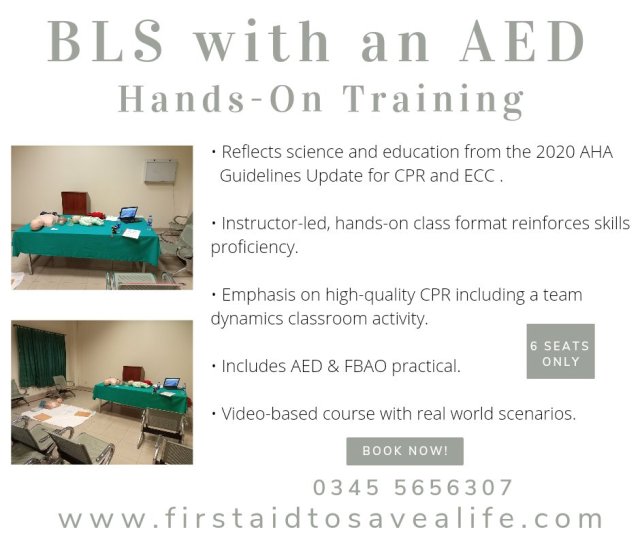
This class provides the basic knowledge to recognize a life-threatening emergency and provide life support when responding to an airway obstruction or cardiac arrest. In our hands-on approach, students participate in scenarios and learning stations.

Features
• Reflects science and education from the latest AHA Guidelines.
• Instructor-led, hands-on class format reinforces skills proficiency.
• Emphasis on high-quality CPR including a team dynamics classroom activity.
• Video-based course with real world scenarios.

Course Topics Include

  • Sudden cardiac arrest
  • Basic life support assessment
  • Caring for respiratory arrest
  • Caring for cardiac arrest
  • Multiple provider approach for CPR
  • Choking

Only 6 seats in the course to offer you ample time and best equipment to student ratio for hands-on learning experience.

For immediate booking contact us on 0345 5656307 or register online.

Posted in First Aid CPR and AED | Tagged , , , , , , , , , , , , , , | Leave a comment

National CPR Training

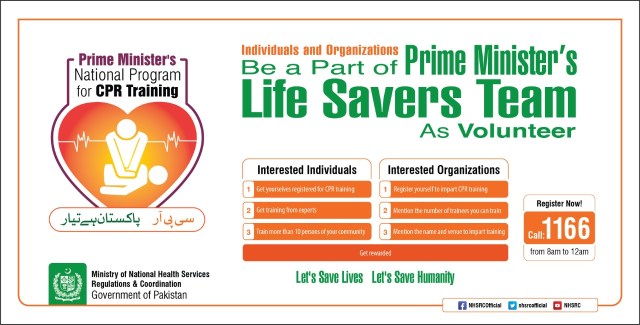
PM National CPR training Registrations are open now.

  1. Call 1166.
  2. Register as Prime Minister’s Life Saver to get trained or if you are certified and want to train others.
  3. Get trained then train 10 or more citizens on basic CPR.
  4. Get rewarded.
Posted in First Aid CPR and AED | Tagged , , , , , , , , , | Leave a comment