Knowing Your Heart and Cardiovascular Disease

Respected All,

We are writing today so that you can learn about your risks for heart disease and stroke and stay “heart health” for yourself and your loved ones.

“What gets measured, get done.”

Let us know about some serious facts about our life style and plan for prevention.
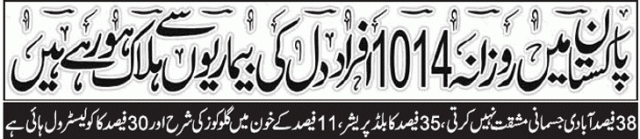
1014 daily deaths

Cardiovascular disease (CVD)—including heart disease, stroke, and high blood pressure—is the number 1 killer of women and men in Pakistan. It is a leading cause of disability, preventing Pakistanis from working and enjoying family activities. CVD costs Pakistan over $20 billion each year, including the cost of health care services, medications, and lost productivity.

Understanding the Burden of CVD 

CVD does not affect all groups of people in the same way. Although the number of preventable deaths has declined in people. Men are more than twice as likely as women to die from preventable CVD.

Having a close relative who has heart disease puts you at higher risk for CVD. Health disparities based on geography also exist. Many CVD deaths could have been prevented through healthier habits, healthier living spaces, and better management of conditions like high blood pressure and diabetes.

Symptoms

Cardiovascular disease is caused by narrowed, blocked or stiffened blood vessels that prevent your heart, brain or other parts of your body from receiving enough blood. Unfortunately, these conditions aren’t often found until after a patient experiences a heart attack or stroke. So understanding the symptoms of these diseases is critical in order to get the right care as quickly as possible.

Symptoms vary depending on what type of heart ailment is present. Cardiovascular disease symptoms may be different for men and women. For instance, men are more likely to have chest pain; women are more likely to have symptoms such as shortness of breath, nausea and extreme fatigue.

Always remember that there are three hallmark symptoms which indicate immediate action should be taken. Seek emergency medical care if you are experiencing:

  • Chest pain
  • Shortness of breath
  • Fainting

Risk factors for CVD

Risk factors for developing heart disease include:

  • Age. Aging increases your risk of damaged and narrowed arteries and weakened or thickened heart muscle.
  • Sex. Men are generally at greater risk of heart disease. However, women’s risk increases after menopause.
  • Family history. A family history of heart disease increases your risk of coronary artery disease, especially if a parent developed it at an early age (before age 55 for a male relative, such as your brother or father, and 65 for a female relative, such as your mother or sister).
  • Smoking. Nicotine constricts your blood vessels, and carbon monoxide can damage their inner lining, making them more susceptible to atherosclerosis. Heart attacks are more common in smokers than in nonsmokers.
  • Poor diet. A diet that’s high in fat, salt, sugar, and cholesterol can contribute to the development of heart disease.
  • High blood pressure. Uncontrolled high blood pressure can result in hardening and thickening of your arteries, narrowing the vessels through which blood flows.
  • High blood cholesterol levels. High levels of cholesterol in your blood can increase the risk of formation of plaques and atherosclerosis.
  • Diabetes. Diabetes increases your risk of heart disease. Both conditions share similar risk factors, such as obesity and high blood pressure.
  • Obesity. Excess weight typically worsens other risk factors.
  • Physical inactivity. Lack of exercise also is associated with many forms of heart disease and some of its other risk factors, as well.
  • Stress. Unrelieved stress may damage your arteries and worsen other risk factors for heart disease.
  • Poor hygiene. Not regularly washing your hands and not establishing other habits that can help prevent viral or bacterial infections can put you at risk of heart infections, especially if you already have an underlying heart condition. Poor dental health also may contribute to heart disease.

“ABC is not always, Airway, Breathing and Circulation. It can be Always Be Careful.”

Plan for Prevention

Try out these strategies for better heart health. You’ll be surprised how many of them can become lifelong habits!

Work with your health care team. Get a checkup at least once each year, even if you feel healthy. A doctor, nurse, or other health care professional can check for conditions that put you at risk for CVD, such as high blood pressure and diabetes—conditions that can go unnoticed for too long.

1:- Monitor your blood pressure.

“35.3% Pakistanis suffer with high blood pressure.”

High blood pressure often has no symptoms, so be sure to have it checked on a regular basis. You can check your blood pressure at home, at a pharmacy, or at a doctor’s office.

2:- Get your cholesterol checked.

“30% Pakistanis have high cholesterol level.”

One should test his cholesterol levels at least once every 5 years. Talk with your health care professional about this simple blood test and monitor your cholesterol level.

3:- Eat a healthy diet. Choosing healthful meal and snack options can help you avoid CVD and its complications. Limiting sodium in your diet can lower your blood pressure. Be sure to eat plenty of fresh fruits and vegetables—adults should have at least five servings each day. Eating foods low in saturated fat, trans fat, and cholesterol and high in fiber. 

4:- Maintain a healthy weight.

“23% Pakistani are overweight.”

Being overweight or obese can increase your risk for CVD. To determine whether your weight is in a healthy range, health care professionals often calculate a number called body mass index (BMI). Doctors sometimes also use waist and hip measurements to measure a person’s body fat. If you know your weight and height, you can calculate your BMI and then try to achieve your BMI level.

5:- Exercise regularly.

“38.4% Pakistanis doesn’t exercise regularly.”

Physical activity can help you maintain a healthy weight and lower cholesterol and blood pressure. Adults should engage in moderate-intensity activity for at least 150 minutes per week. Remember to incorporate exercise into your day in different ways: take the stairs instead of the elevator etc. Exercising with friends and family can be a great way to stay healthy and have fun.

6:- Don’t smoke. Cigarette smoking greatly increases your risk for CVD. If you don’t smoke, don’t start. If you do smoke, quit as soon as possible. Your health care team can suggest ways to help you quit.

7:- Manage your diabetes.

“11.7% Pakistanis have high blood sugar.”

If you have diabetes, monitor your blood sugar levels closely, and talk with your health care team about treatment options.

8:- Take your medicine. If you’re taking medication to treat high blood pressure, high cholesterol, diabetes, or another condition, follow the instructions carefully. Always ask questions if you don’t understand something. If you have side effects, talk with your health care team about your options.
Share this post and let others learn more about heart health.


We look forward to your valuable feedback.

To Your Safety,
Faisal Javed Mir & First Aid to Save a Life Pakistan

Did you like the post? Let’s get connected on Facebook, LinkedIn, Twitter & YouTube.

You might also like:
First Aid, CPR & AED – International Certification Course
AEDs Implementation Plan
Snakebite First Aid Management Training
Posted in World Heart Day | Tagged , , , , , , , , , , , , , , , , , , , , , , , , , , , , , , , , , , , , , , , , , , , , , , , , , , , | 6 Comments

Improve Your Site’s Emergency Response Plan to Save More Lives

Respected All,

Businesses not only provide services to countless customers, but also have to care for their employees. Given the number of people present and the considerable amount of time and activity spent at work, the risk of someone suffering cardiac arrest at your facility is very real. Durable, cost-effective, low-maintenance, and easy-to-use AEDs are perfectly suited for the unique needs of the business environment.

It is the responsibility of businesses to provide resources and trainings to enable employees to avoid accidents and act swiftly in an unfortunate case to lessen the severity of injury and rescue the patient to save as many lives they can and limit the other losses.

Many organizations in Pakistan have developed Emergency Rescue & Response Plans but very few have AEDs at their site to save as many lives they can because of Sudden Cardiac Arrest which can strike anytime, anywhere and to anyone (infant, child and/or adult).

Why do we need AEDs?

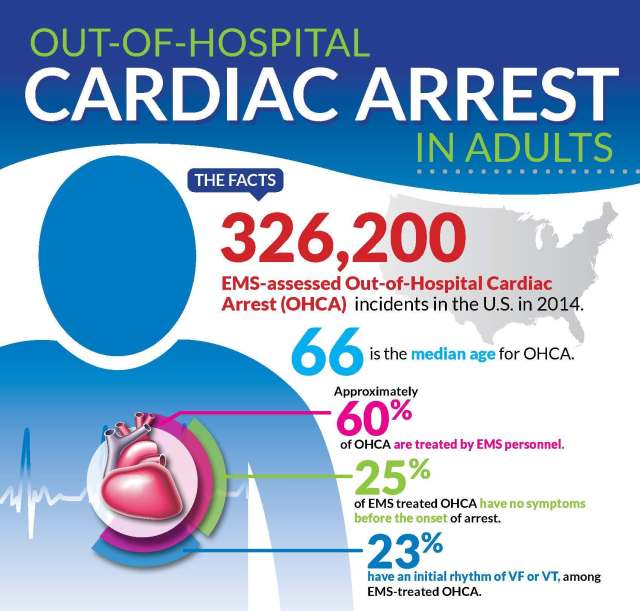
AEDs save lives. When a person has a Sudden Cardiac Arrest, the heart becomes arrhythmic. Every minute that the heart is not beating lowers the odds of survival by 7 percent to 10 percent. After 10 minutes without defibrillation, very few people survive.

OHCA Infographic

Does your company keep its lifesaving device(s) in an easy-to-access, visible spot? OSHA’s informational booklet, Saving Sudden Cardiac Arrest Victims in the Workplace, offers up a thoughtful list of optimal places for facility managers to keep in mind when installing an AED:

  • AEDs should be conveniently installed to ensure response within 3-5 minutes.
  • Areas where many people work closely together, such as assembly lines and office buildings.
  • Close to a confined space.
  • Areas where electric-powered devices are used.
  • Outdoor worksites where lightning may occur.
  • Health units where workers may seek treatment for heart attack symptoms.
  • Company fitness units and cafeterias.
  • Remote sites, such as off-shore drilling rigs, construction projects, marine vessels, power transmission lines, and energy pipe lines.

But purchasing your device and mounting it in an appropriate spot isn’t the end of the story. An early defibrillation program is part of a commitment to the health and safety of your employees, customers, and vendors. An AED and early defibrillation program can improve survival rates, raising them as high as 60% in some estimates.

What First Aid to Save a Life Pakistan can do for us?

First Aid to Save a Life Pakistan can integrates all required components of a successful AED program while ensuring compliance with local, international and industry laws. We can plan for you a worry-free AED implementation program, which is very easy to manage.

Sudden Cardiac Arrest (SCA) is unpredictable.

Quick response and early use of an AED can make the difference between life and death. By implementing a comprehensive AED program, you will be creating a safer environment for your employees, visitors and everyone in and around your facility.

Unfortunately, most of the time, the necessary life-saving equipment does not arrive in time. As a result, typical survival rates are only 2%-5%.

Now there is something you can do to improve the odds dramatically for your community, business, schools, shopping malls, health clubs, hospitality services, personal use, public access and professional rescue services with a solution that is easy to use and inexpensive to buy.

Our life-saving AED program goes beyond simply having an AED. Our different proposed programs will help you choose one for you to feel comfortable with it and saving lives. These programs will help you prepare your people and organization before sudden cardiac arrest strikes.

The bottom line is that with a modest investment, now you can have a heart-safe environment, where you live and work.

Kindly find attached a detailed AED Implementation Plan and a wall poster on AED Implementation Program.

Kindly visit our upcoming trainings page for more comprehensive details and/or our online registration page. Do let us know if you have 1o or more number of delegates to be trained in one city and we can join you to run the session at your premises.


To Your Safety,
Faisal Javed Mir & First Aid to Save a Life

Did you like the post? Let’s get connected on Facebook, LinkedIn, Twitter & YouTube.

You might also like:

First Aid, CPR & AED Session in Lahore

First Aid CPR & AED Session in Islamabad

Introducing First Aid Trainings for Families
AEDs Implementation Plan
Snakebite First Aid Management Training
Posted in 1-Day Training Programs, Advanced First Aid, AEDs, Basic First Aid, CPR and AED, emergency care and first aid, Emergency First Aid, First Aid, First Aid and CPR, First Aid CPR and AED, First Aid Training Programs | Tagged , , , , , , , , , , , , , , , , , , , , , , , , , , , , , , , , , , , , , , , , , , , , , , , , , , , , , , , , , , , , , , , , , , , , , , , , , , , , , , , , , , , , , , , , , , , , , , , | Leave a comment

School Safety Program

Respected All,

School Safety Program is to serve our education sector and for them to take pride in managing their schools, colleges, campuses more safely and claiming to have better controls in place to prevent accidents in their premises and better equipped to control if the undesired situations arise.

Let us answer some of the most common questions, first to help you understand this initiative and how you can benefit from it.

What is the purpose of this program?

Answer: School/college/university/campus/organization wants to show responsibility by making sure that its campus, facilities, transport facilities, equipment and other services comply with health & safety, environmental and social responsibility imperatives, whether they are:

Regulatory: imposed by applicable codes or regulations which condition the “license to operate”,

Proprietary: based on your own schemes, standards, requirements or vision.

With this they have committed to improving their level of preparedness and if they are enlighten with this vision then First Aid to Safe a Life (FATSAL) Pakistan is the only organization in Pakistan who can take them along to achieve this goal.

Our School Safety Program provides a framework designed to:

1) Help Schools, Colleges & Education Campuses become prepared for emergencies;

2) Help increase the level of preparedness among staff, individuals and families; and

3) Encourage Schools, Colleges & Education Campuses to help their students learn basics of emergency preparedness.

What’s different about this one?

Answer: This program does more than provide useful emergency preparedness information. Our training will help you to understand basics of emergency preparedness and approach to identify hazards and take effective and measurable steps to control all risk factors. Additionally, we can provide a number of services to enhance emergency preparedness efforts and support you to maintain compliance over a period of time through continuous and surprise checks.

Can anyone become a member of the program?

Answer: Any school, campus or organization who is committed to improving their emergency preparedness is welcomed and encouraged to join this program.

Why do you think this program will be effective?

Answer: We are experienced to address the important components of preparedness so you can have better control over hidden hazards and manage them efficiently if the need arise. Our program not only provides members with helpful information – it also recognizes members for their efforts.

Why is there a need for this program now?

Answer: Pakistan lack a mindset in safety and if it is true then schools are the best place to go and correct what went wrong and encourage our coming generation to plan ahead and prepare to prevent and if not possible to avoid it then put in place some plans to mitigate. lack a mindset in safety. We can’t let adversity knock on the door to learn what we failed to have plans in place or skilled staff to manage this incident efficiently to avoid losses to human, environment, assets and repute of organization! Can we? The injury and/or loss of life of a child is unbearable pain that parents had to go through. So we have to BE READY to deal with emergencies as they can happen at any time, so there is a constant need to prepare for emergencies.

If you plan for a year, plant a seed. If for ten years , plant a tree. If for hundred years, teach the people.”

We are able to carry out inspections and trainings and establish a systems and processes to manage such risk factors to avoid incidents and prepared for them in advance. First Aid to Save a Life (FATSAL) Pakistan have a comprehensive consultancy and training package for schools and education campus to get your staff trained in emergency management system and skills, this not only includes how to manage developing hazards, fire, earthquake, injury and/or medical illness.

In the meantime, you can always use our email faisal@firstaidtosavealife.com if you queries or call +92 324 6816307 / 0333 5103798 to find out more about our training and consultancy services or getting the equipment you need.

To Your Health, Safety & Prosperity;

Faisal Javed Mir & First Aid to Save a Life Pakistan

Did you like the post? Let’s get connected on FacebookLinkedInTwitter & YouTube.

You might also like:

Posted in School & Education Campus Safety | Tagged , , , , , , , , , , , , , , , , , , , , , , , , , , , , , , | 1 Comment

First Aid, CPR & AED – An International Certification Course

Respected All,

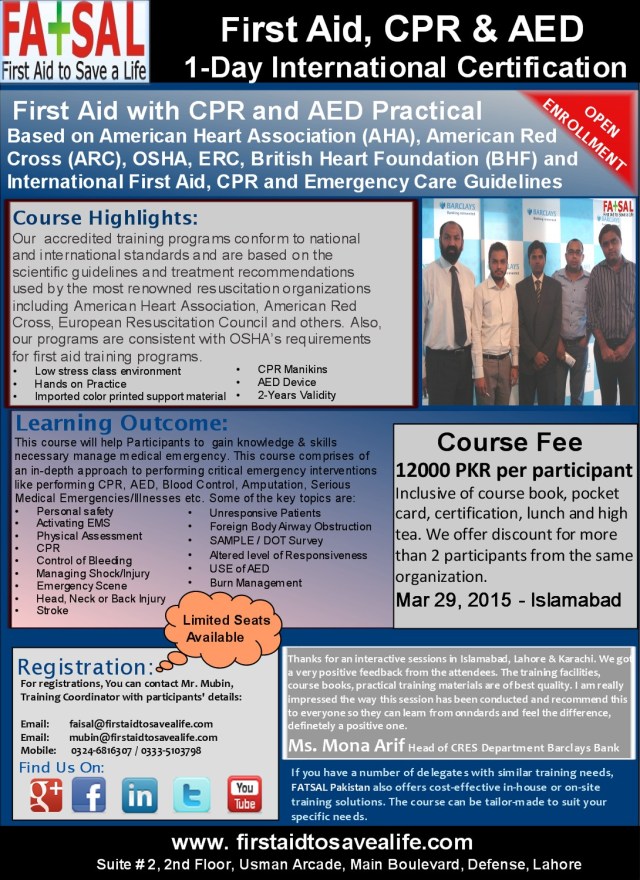
First Aid to Save a Life (FATSAL) Pakistan is pleased to announce their upcoming “CPR, AED & First Aid” International Training Certification Course in Islamabad on March 29, 2015.

FACPRAED 29Mar15-ISB

This is a registered training course and globally recognized. This training program is designed specifically for the occupational first aid provider and fulfills industry requirements. The course is based on the latest guidelines for CPR and First Aid.

This course will help students to gain the knowledge skills, and confidence necessary to manage a medical emergency using CPR and first aid until more advanced help is available. Also, participants will get real life experience to use Automated External Defibrillator (AED). This training familiarizes the candidates with the latest concepts in emergency/workplace first aid according to latest guidelines released by 19 resuscitation councils of the world.

Kindly remember that we have limited seats available in each course so don’t wait for last week and finalize your registration as early as possible to confirm your participation.

Kindly visit our upcoming trainings page for more comprehensive details and/or our online registration page. Do let us know if you have 1o or more number of delegates to be trained in one city and we can join you there to run the session for your organization.

Everyone likes to think they are different. We are the same but let me assure you its not just talk. Frankly we try much harder to offer a more attentive, imaginative and enhanced and credible learning experiences.

Equipments available for Training:
1:- 2-professional adult CPR-AED training manikins (with CPR monitor) for realistic experiences and feedback.
2:- 1-professional infant manikins.
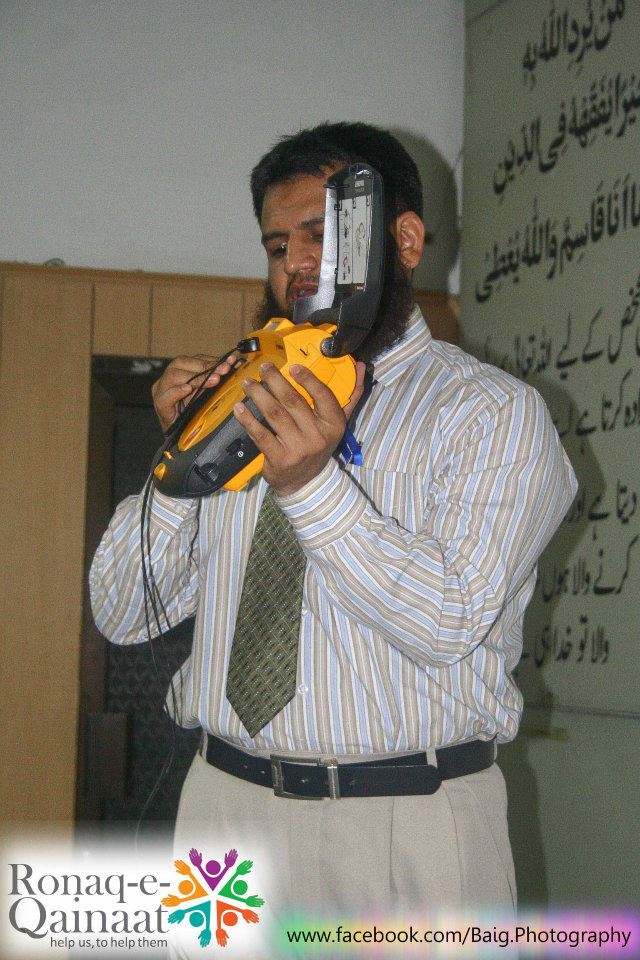
3:- AED device for training purpose.
4:- First aid supplies for pure training purposes.
5:- First Aid Box will be available for filling and re-filling exercises.

Course Benefits & Key Features:
01:- Certification: Successful participants will receive (individual) successful accredited certificate with 2-years validity card.
02:- Training Booklet: Full-color Student Guide Book from approved course contents.
03:- Wallet Skill Card: A personal wallet skill guide card which can be used for quick reference/revision.
04:- Award-winning, professionally produced videos.
05:- A proven “seeing, hearing, doing, speaking, feeling” approach to learning.
06:- Low-stress training with user-friendly materials and positive coaching.
07:- Significant classroom time for hands-on practice.
08:- Performance-based student evaluation.

You are kindly requested to disseminate this training course to your respective organizations and colleagues so that they can positively participate in the said training program and acquire the benefits.

We look forward to your valuable cooperation and support.

To Your Safety,
Faisal Javed Mir & First Aid to Save a Life Pakistan

Did you like the post? Let’s get connected on Facebook, LinkedIn, Twitter & YouTube.

You might also like:
Campus Safety Program
AEDs Implementation Plan
Snakebite First Aid Management Training

Posted in 1-Day Training Programs, Advanced First Aid, AEDs, Basic First Aid, CPR and AED, emergency care and first aid, Emergency First Aid, First Aid, First Aid and CPR, First Aid CPR and AED, First Aid Training Programs | Tagged , , , , , , , , , , , , , , , , , , , , , , , , , , , , , , , , , , , , , , , , , , , , , , , , , , , , , , , , , , , , , , , , , , , , , | 10 Comments

First Aid, CPR & AED – An International Training Certificate

Respected All,

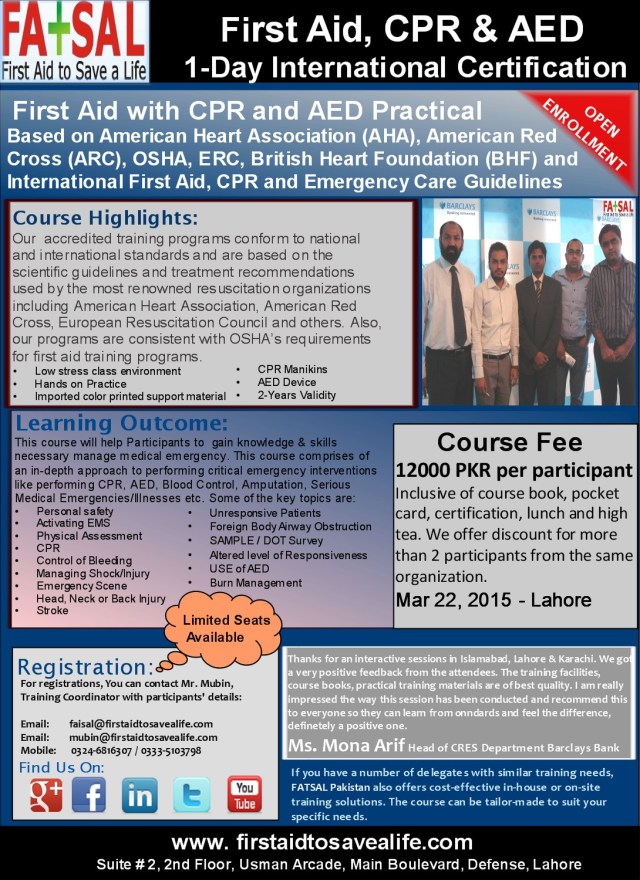
First Aid to Save a Life (FATSAL) Pakistan is pleased to announce their upcoming “CPR, AED & First Aid” International Training Certification Course in Lahore on March 22, 2015.

FACPRAED 22Mar15-LHR


This is a registered training course and globally recognized. This training program is designed specifically for the occupational first aid provider and fulfills industry requirements. The course is based on the latest guidelines for CPR and First Aid.

This course will help students to gain the knowledge skills, and confidence necessary to manage a medical emergency using CPR and first aid until more advanced help is available. Also, participants will get real life experience to use Automated External Defibrillator (AED). This training familiarizes the candidates with the latest concepts in emergency/workplace first aid according to latest guidelines released by 19 resuscitation councils of the world.

Kindly remember that we have limited seats available in each course so don’t wait for last week and finalize your registration as early as possible to confirm your participation.

Kindly visit our upcoming trainings page for more comprehensive details and/or our online registration page. Do let us know if you have 1o or more number of delegates to be trained in one city and we can join you there to run the session for your organization.

Everyone likes to think they are different. We are the same but let me assure you its not just talk. Frankly we try much harder to offer a more attentive, imaginative and enhanced and credible learning experiences.

Equipments available for Training:
1:- 2-professional adult CPR-AED training manikins (with CPR monitor) for realistic experiences and feedback.
2:- 1-professional infant manikins.
3:- AED device for training purpose.
4:- First aid supplies for pure training purposes.
5:- First Aid Box will be available for filling and re-filling exercises.

Course Benefits & Key Features:
01:- Certification: Successful participants will receive (individual) successful accredited certificate with 2-years validity card.
02:- Training Booklet: Full-color Student Guide Book from approved course contents.
03:- Wallet Skill Card: A personal wallet skill guide card which can be used for quick reference/revision.
04:- Award-winning, professionally produced videos.
05:- A proven “seeing, hearing, doing, speaking, feeling” approach to learning.
06:- Low-stress training with user-friendly materials and positive coaching.
07:- Significant classroom time for hands-on practice.
08:- Performance-based student evaluation.

You are kindly requested to disseminate this training course to your respective organizations and colleagues so that they can positively participate in the said training program and acquire the benefits.

We look forward to your valuable cooperation and support.

To Your Safety,
Faisal Javed Mir & First Aid to Save a Life Pakistan

Did you like the post? Let’s get connected on Facebook, LinkedIn, Twitter & YouTube.

You might also like:
Campus Safety Program
AEDs Implementation Plan
Snakebite First Aid Management Training
Posted in 1-Day Training Programs, Advanced First Aid, AEDs, Basic First Aid, CPR and AED, emergency care and first aid, Emergency First Aid, First Aid, First Aid and CPR, First Aid CPR and AED, First Aid Training Programs | Tagged , , , , , , , , , , , , , , , , , , , , , , , , , , , , , , , , , , , , , , , , , , , , , , , , , , , , , , , , , , | Leave a comment

Fitness Trainers and CPR-AED-First Aid Training Requirement

Annie, Annie…are you okay?

As fitness professionals, you have to work every day with people who are stressing their bodies. Often these are overweight, out of shape and high risk clients. People who might be at risk for a heart attack or coronary arrest. But they aren’t the only ones in danger. Even your fittest (footballers suffered Sudden Cardiac Arrest (SCA) in recent times on play field), most athletic client could choke on a piece of gum on their way into your gym.  Would you know what to do?

CPR-AED Training is a mandatory requirement for all Fitness (Gym Instructor, Group Exercise, Aqua Instructor), Sports Trainer & Community Activity Programs Coaches.

Some of the best Fitness Associations who require CPR-AED training as illegibility criteria for fitness training profession, some of them are:

American Council on Exercise (ACE);

International Sports Sciences Association (ISSA); &

Australian Fitness Academy (AFA);

What about first aid? Isn’t that important too?  Actually, chances are you are going to run into a cut, scrape, sprained ankle, or upset stomach before you see a heart attack. It is valuable knowledge to have and you’ll likely feel more comfortable practicing as a fitness professional with this skill set. At this time, however, ACE does not require a certificate in First Aid, but an optional training requirement.

American Council on Exercise (ACE) requires certification exam candidates to hold current Adult CPR and AED (automated external defibrillator) certificates prior to sitting for the exam. They also require ACE certified professionals to provide proof of their CPR/AED certificates at the time of renewal.

But not just any CPR course will do. Online certifications are not acceptable by any of the associations. ACE requires that candidates complete an Adult CPR/AED course with a live skills check. This means there is a living, breathing instructor watching and checking off your skill performance. An online only CPR course alone cannot provide this live skills check.

First Aid to Save a Life (FATSAL) Pakistan is pleased to offer internationally accredited practical training course, First Aid, CPR and AED in Pakistan.

This is a registered training course and globally recognized. This training program is designed specifically for the first aid providers and fulfills fitness industry requirements. The course is based on the American Heart Association (AHA) and other recognized training and resuscitation organization’s guidelines for CPR, AED and First Aid.

This course will help students to gain the knowledge skills, and confidence necessary to manage a medical emergency using CPR and first aid until more advanced help is available. Also, participants will get real life experience to use Automated External Defibrillator (AED). This training familiarizes the candidates with the latest concepts in emergency/workplace first aid according to latest guidelines released by 19 resuscitation councils of the world.

Kindly visit our upcoming trainings page for more comprehensive details and/or our online registration page. Do let us know if you have 1o or more number of delegates to be trained in one city and we can join you there to run the session for your organization.

Everyone likes to think they are different. We are the same but let me assure you its not just talk. Frankly we try much harder to offer a more attentive, imaginative and enhanced and credible learning experiences.

Equipments available for Training:
1:- 2-professional adult CPR-AED training manikins (with CPR monitor) for realistic experiences and feedback.
2:- 1-professional infant manikins.
3:- AED device for training purpose.
4:- First aid supplies for pure training purposes.
5:- First Aid Box will be available for filling and re-filling exercises.

Course Benefits & Key Features:
01:- Certification: Successful participants will receive (individual) successful accredited certificate with 2-years validity card.
02:- Training Booklet: Full-color Student Guide Book from approved course contents.
03:- Wallet Skill Card: A personal wallet skill guide card which can be used for quick reference/revision.
04:- Award-winning, professionally produced videos.
05:- A proven “seeing, hearing, doing, speaking, feeling” approach to learning.
06:- Low-stress training with user-friendly materials and positive coaching.
07:- Significant classroom time for hands-on practice.
08:- Performance-based student evaluation.

You are kindly requested to disseminate this training course to your respective organizations and colleagues so that they can positively participate in the said training program and acquire the benefits.

We look forward to your valuable cooperation and support.

To Your Safety,
Faisal Javed Mir & First Aid to Save a Life Pakistan

Did you like the post? Let’s get connected on Facebook, LinkedIn, Twitter & YouTube.

You might also like:
CPR HOPE
AEDs Implementation Plan
The Best Defibrillator
Snakebite  Management Training
School & Education Campus Safety Program

Posted in 1-Day Training Programs, First Aid CPR and AED, Fitness Instructors | Tagged , , , , , , , , , , , , , , , , , , , , , , , , , , , , , , , , , , , , , , , | 2 Comments

AED Placement and Management in Your Facility

Respected All,

Why do we need AEDs?

AEDs save lives. When a person has a Sudden Cardiac Arrest, the heart becomes arrhythmic. Every minute that the heart is not beating lowers the odds of survival by 7 percent to 10 percent. After 10 minutes without defibrillation, very few people survive.

SCA infographic

Why Choose Automated External Defibrillators (AEDs)?

Businesses not only provide services to countless customers, but also have to care for their employees. Given the number of people present and the considerable amount of time and activity spent at work, the risk of someone suffering cardiac arrest at your facility is very real. Durable, cost-effective, low-maintenance, and easy-to-use Defibtech AEDs are perfectly suited for the unique needs of the business environment.

Does your company keep its lifesaving device(s) in an easy-to-access, visible spot? OSHA’s informational booklet, Saving Sudden Cardiac Arrest Victims in the Workplace, offers up a thoughtful list of optimal places for facility managers to keep in mind when installing an AED:

  • AEDs should be conveniently installed to ensure response within 3-5 minutes.
  • Areas where many people work closely together, such as assembly lines and office buildings.
  • Close to a confined space.
  • Areas where electric-powered devices are used.
  • Outdoor worksites where lightning may occur.
  • Health units where workers may seek treatment for heart attack symptoms.
  • Company fitness units and cafeterias.
  • Remote sites, such as off-shore drilling rigs, construction projects, marine vessels, power transmission lines, and energy pipe lines.

But purchasing your device and mounting it in an appropriate spot isn’t the end of the story. An early defibrillation program is part of a commitment to the health and safety of your employees, customers, and vendors. An AED and early defibrillation program can improve survival rates, raising them as high as 60% in some estimates.

What is this Sudden Cardiac Arrest?

The killer of more than 400,000 people a year in USA and more than 100,000 people a year in Pakistan, sudden cardiac arrest (SCA) causes the heart’s normal rhythm to suddenly become chaotic. The heart can no longer pump the blood effectively and the victim collapses, stops breathing, becomes unresponsive, and has no detectable pulse. SCA can strike anyone, anytime. Children, teenagers, athletes, old people — can all have SCAs. Although the risk of SCA increases with age and in people with heart problems, a large percentage of the victims are people with no known risk factors.

What is the recommended treatment of SCA?

Defibrillation is the only treatment proven to restore a normal heart rhythm. When used on a victim of SCA, the automated external defibrillator (AED) can be used to administer a lifesaving electric shock that restores the heart’s rhythm to normal. AEDs are designed to allow non-medical personnel to save lives.

How much time do I have to respond if someone has a SCA?

As said above it allows only minutes when it strikes to initiate AED. Defibrillate within three minutes and the chances of survival are 70 percent. After 10 minutes, the chances of survival are negligible.

I know CPR; would not it help?

CPR only buys a little more time, potentially giving the victim a small amount of extra time until a defibrillator arrives. But SCA ultimately requires a shock to restore a normal heart rhythm. As a result, most CPR training now also includes AED training.

For those who suffer a cardiac arrest outside of the hospital, the chance of survival is less than 10%. Brain damage can occur in 4 minutes and for every minute without CPR, the chance of survival goes down by 10%.

What First Aid to Save a Life Pakistan can do for us?

First Aid to Save a Life Pakistan can integrates all required components of a successful AED program while ensuring compliance with local, international and industry laws. We can plan for you a worry-free AED implementation program, which is very easy to manage.

Sudden Cardiac Arrest (SCA) is unpredictable. It can happen anywhere, at any time, to anyone. 581183_364160330298205_128817247165849_942834_1203825455_nQuick response and early use of an AED can make the difference between life and death. By implementing a comprehensive AED program, you will be creating a safer environment for your employees, visitors and everyone in and around your facility.


Unfortunately, most of the time, the necessary life-saving equipment does not arrive in time. As a result, typical survival rates are only 2%-5%.

Now there is something you can do to improve the odds dramatically for your community, business, schools, shopping malls, health clubs, hospitality services, personal use, public access and professional rescue services with a solution that is easy to use and inexpensive to buy.

Our life-saving AED program goes beyond simply having a Defibtech Lifeline AED. Our different proposed programs will help you choose one for you to feel comfortable with it and saving lives. These programs will help you prepare your people and organization before sudden cardiac arrest strikes.

The bottom like is that with a modest investment, now you can have a heart-safe environment, where you live and work.

1- AED placement analysis and site survey: This offers AED placement assistance for optimal emergency response time. The survey of your location/facility/office will help us to find a best suitable place for installation of AED. A formal report will be generated

2- Program Policies and Procedures: First Aid to Save a Life Pakistan will help your organization in developing certain set of policies and procedure to ensure program readiness. With the help of your organization, FATSAL will help you defines roles and responsibilities for Emergency Response Team personnel and other administrative tasks within your organization to ensure readiness.

3- Trainings Program: First Aid to Save a Life Pakistan can plan accredited professional trainings ranging from half day to five days training programs to train:

Program Administrators/Coordinators;

Emergency Response Team members; &

Employees.

4- AED device installations: First Aid to Save a Life Pakistan will install AED device on the recommendations of report generated through AED placement and site survey activities. The following parts will be part of Defibtech AED device.

  • Defibtech Lifeline AED Device;
  • Lithium Battery Pack;
  • 9v Battery;
  • 1 pair of adult electrode pads;
  • Soft carrying case. &
  • User manual

5- Early Preparedness & Emergency Response (Check) Drills: First Aid to Save a Life Pakistan will plan drills to record the response to gauge its effectiveness and suggest remedial action plan (if required after drill) to reduce response time and evaluate the response procedure to avoid this in future.

6- Program Tracker: First Aid to Save a Life Pakistan will run their inspections, drills, and check the knowledge and skills learned during the training sessions to see if there are any deficiencies or any non-compliance observed during this bi-annually program tracking audit. This part of the comprehensive AED program will also highlight:

  • AED inspection reminders;
  • Battery & pad notifications sent 60 and 30 days prior to expiration.
  • Reminder emails sent 90, 60, and 30 days prior to personnel training expiration.
  • Reminder emails on remedial action plan items (RAPIs).
  • Reminder emails on upcoming emergency response drills

Kindly find attached a detailed AED Implementation Plan and a wall poster on AED Implementation Program.

CPR HOPE is a positive educational experience designed for anyone who desires to learn this potentially life-saving skill; children attending school, family members and friends, or members of our local, education, or business communities.

This is your invitation to join us to learn to save as many lives as possible. CPR HOPE will be offered on Saturday and Sunday September 6th and 7th, 2014 from 0900 to 1700 hours at Hotel Pak Continental, G-8 Markaz, Islamabad.

To Your Safety,
Faisal Javed Mir & First Aid to Save a Life Pakistan

Did you like the post? Let’s get connected on Facebook, LinkedIn, Twitter & YouTube.

You might also like:
CPR HOPE
AEDs Implementation Plan
The Best Defibrillator
Snakebite  Management Training
School & Education Campus Safety Program

Posted in 1-Day Training Programs, AED Implementation Program, AEDs | Tagged , , , , , , , , , , , , , , , , , , , , , , , , , , , , , , , , , , , , , , , , , , , | 2 Comments

CPR HOPE

Respected All,

Compressions-Only CPR (also called Hands-Only CPR) is basically offered to the community. This program is offered as “CPR HOPE” that is CPR Hands On Practical Experience. In last 5 to 8 years chest compressions-only CPR has shown to be as effective as regular CPR.

CPR HOPE3

For those who suffer a cardiac arrest outside of the hospital, the chance of survival is less than 10%. Brain damage can occur in 4 minutes and for every minute without CPR, the chance of survival goes down by 10%.

SCA infographicCPR HOPE is a positive educational experience designed for anyone who desires to learn this potentially life-saving skill; children attending school, family members and friends, or members of our local, education, or business communities.

This is your invitation to join us to learn to save as many lives as possible. CPR HOPE will be offered on Saturday and Sunday September 6th and 7th, 2014 from 0900 to 1700 hours at Hotel Pak Continental, G-8 Markaz, Islamabad.

The FB page can be found:

https://www.facebook.com/events/322366317911158/


To Your Safety,
Faisal Javed Mir & First Aid to Save a Life Pakistan

Did you like the post? Let’s get connected on Facebook, LinkedIn, Twitter & YouTube.

You might also like:
Introducing First Aid Trainings for Families
AEDs Implementation Plan
Snakebite First Aid Management Training

Posted in First Aid CPR and AED | Tagged , , , , , , , , , , | 2 Comments

Protect Yourself from Heat Illness

Respected All,

Sun

Working outdoors this summer? It’s all about water, rest, shade and knowing about the heat related problems and how to protect yourself.

Every year, thousands of workers become sick from exposure to heat, and some even die. Heat illnesses and deaths are preventable. Employers are responsible for providing workplaces that are safe from excessive heat and training to their employees how to manage it.

Heat related problems occur when the body’s normal temperature-reducing mechanisms get overwhelmed, especially during vigorous physical activity or working under direct sunlight, and become inefficient or stop working.

The body normally cools itself by sweating. During hot weather, especially with high humidity, sweating isn’t enough. Body temperature can rise to dangerous levels if precautions are not taken such as drinking water frequently and resting in the shade or air conditioning. Heat illnesses range from heat rash and heat cramps to heat exhaustion and heat stroke. Heat stroke requires immediate medical attention and can result in death.

How can heat illness be prevented?

Employers should establish a complete heat illness prevention program to prevent heat illness. This includes: provide workers with water, rest and shade; gradually increase workloads and allow more frequent breaks for new workers or workers who have been away for a week or more to build a tolerance for working in the heat (acclimatization); modify work schedules as necessary; plan for emergencies and train workers about the symptoms of heat-related illnesses and their prevention; and monitor workers for signs of illness. Workers new to the heat or those that have been away from work and are returning can be most vulnerable to heat stress and they must be acclimatized.

To prevent heat related illness and fatalities:

  • Drink water every 15 minutes, even if you are not thirsty.
  • Rest in the shade to cool down.
  • Wear a hat and light-colored clothing.
  • Learn the signs of heat illness and what to do in an emergency.
  • Keep an eye on fellow workers.
  • “Easy does it” on your first days of work in the heat. You need to get used to it.

If workers are new to working in the heat or returning from more than a week off, and for all workers on the first day of a sudden heat wave, implement a work schedule to allow them to get used to the heat gradually.

Remember these three simple words: Water, Rest, Shade. Taking these precautions can mean the difference between life and death.

water rest shade

Who is affected?

Any worker exposed to hot and humid conditions is at risk of heat illness, especially those doing heavy work tasks or using bulky protective clothing and equipment. Some workers might be at greater risk than others if they have not built up a tolerance to hot conditions, including new workers, temporary workers, or those returning to work after a week or more off. This also includes everyone during a heat wave.

Industries most affected by heat-related illness are: construction; trade, transportation and utilities; agriculture; building, grounds maintenance; landscaping services; and support activities for oil and gas operations.

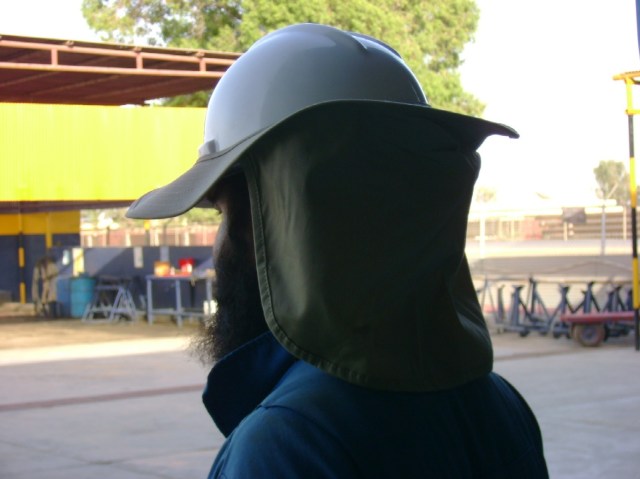
Hard Hat - Sun Rays Protector1

Keep your colleagues and yourself safe from heat hazards such as heat stress, heat exhaustion, and heat stroke. Follow these simple guidelines for sun protection and safe hot weather work practices.

Need some extra training? First Aid to Save a Life (FATSAL) offers a Heat Stress course excellent for workers in all industries. The course uses a common-sense approach and features preventive measures for reducing the chances of suffering from heat-related disorders such as heat cramps, heat exhaustion, and heat stroke.

To Your Safety,
Faisal Javed Mir & First Aid to Save a Life Pakistan

Did you like the post? Let’s get connected on Facebook, LinkedIn, Twitter & YouTube.

You might also like:

First Aid for Heat Stress

Training Supplies

AEDs Implementation Plan

Posted in First Aid CPR and AED | Tagged , , , , , , , , , , , , , , , , , , , , , , , , , , , , , , , , , , , , , , , | Leave a comment

Bite the Bullet

Respected All,

Safe practices at work, home, and play can prevent many injuries, illnesses, and deaths. However, once injury or sudden illness has occurred, effective first aid can make the difference between a rapid or prolonged recovery, a temporary or permanent disability, and even a life or death.

In general we lack a mindset in personal safety and/or proactive and safe approach towards our personal and/or family health and safety issues like first aid training requirements.

Basic and Emergency First Aid is mandatory in USA, Europe, Australia, Canada and other developed countries. In recent London Olympics more than 2700 First Aiders volunteered their services but in Pakistan we hardly get few hundreds of first aiders in cities like Karachi, Lahore and Islamabad. This is because here in Pakistan people fear police case as a result of performing first aid in an emergency so they don’t step up to help others which is really alarming. We can manage this fear by spreading this information to help all Pakistanis to understand more about the legal support offered to them by the national law and one provincial law (by Punjab province).

Below is the extract from the article written for The Express Tribune on June 15, 2014.

Time is of the essence when it comes to treating a gunshot wound.

Kindly visit below link to read full article, Bite the Bullet, on The Express Tribune.

To Your Safety,
Faisal Javed Mir & First Aid to Save a Life Pakistan

Did you like the post? Let’s get connected on Facebook, LinkedIn, Twitter & YouTube.

You might also like:

Training Supplies

Barrier Devices – Personal Safety Items

Introducing First Aid Trainings for Families

AEDs Implementation Plan

Posted in First Aid CPR and AED | Tagged , , , , , , , , , , , , , , , , , , , , , , , , , , , , , , , , , , , , , , | Leave a comment